Now booking: collection runs across Jefferson and Shelby counties — start an estimate
Repair & Restoration

Rug Repair & Reweaving in Birmingham

A shredded end, a side cord that has split open, grazing behind the sofa, a corner the puppy laid claim to, or a rug that spent a night on the wet side of a half-heated lower room. Very little of that is actually terminal.

At the Loom

Rebuilt in the Order It Was Woven

Filling a hole and rebuilding one are not the same trade. A rug goes back together the way the weaver worked it — warp and weft re-established first, knots laid in afterwards at the original density and dye lot — so the mended ground shifts and wears alongside the field rather than against it. Do that properly and the only way to find the repair is to be shown where it is.

None of it is quick. Reweaving advances an inch at a time, and a pair of hands at a loom remains the only honest way through it. What you get in exchange is that the damage owners have already written off is usually nothing of the kind. Rugs come in folded around the gap and leave lying flat.

Assessment costs nothing and arrives with a verdict attached. Where the work would run past what the piece is worth to anybody, you hear that before a bench is booked. We would sooner lose the job than take it quietly.

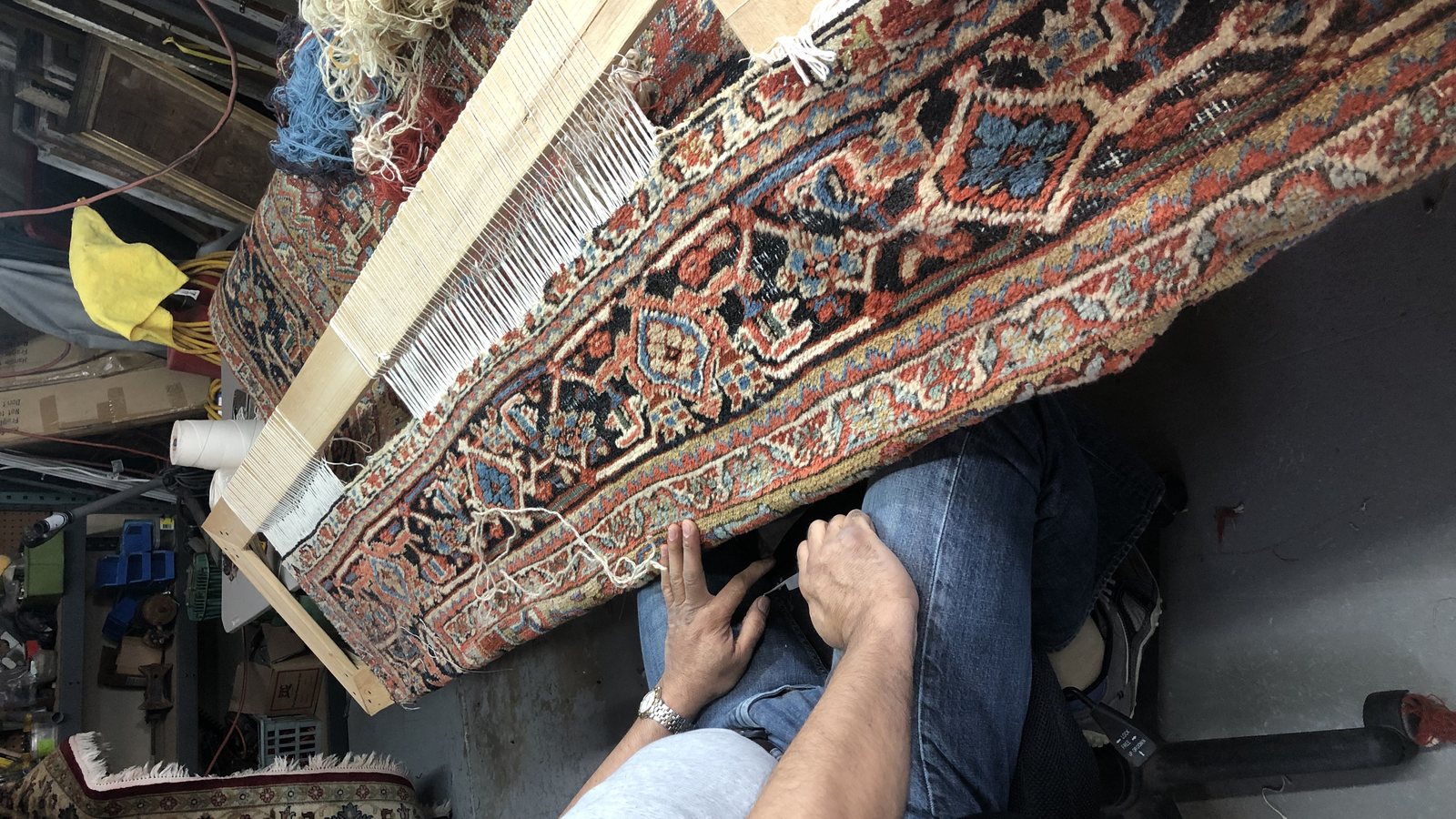
Matched wool being knotted back into an oriental rug at the repair bench
Matched wool going back into a rebuilt foundation one knot at a time.
The Bench

What Can Be Put Right

Anything from steadying a frayed end to putting a foot of lost border back where it belongs.

Ends & Fringe

Those tassels are warp ends coming out of the weave, not trim stitched onto it. Once they start shedding, the rug is coming apart from the end inward. The last row gets secured, lost warps are put back, and the finish is matched to whatever was there.

Selvedges & Side Cords

The wrapped sides absorb every vacuum beater and chair leg in the room. When one splits, the knots alongside it begin releasing within weeks. Sides are rewrapped by hand in matched wool before that runs any further.

Holes, Burns & Tears

Worn-through ground is rebuilt a knot at a time: structure first, then pile matched on fiber, shade and density, then sheared level with the field so nothing catches the light at a different angle.

Moth Grazing

Larvae feed on the underside, so bare foundation showing through means the problem has been running for a while. Garages, attics and the half-heated lower rooms so many houses here step down into are where it starts. Infestation is cleared first, grazed ground rebuilt second.

Pet Damage

Chewed corners, clawed sides, and dye burned away by urine that was left to sit. Decontamination comes before anything structural; then the missing material goes back and color is rebuilt where the original was destroyed outright.

Color & Dye Correction

Bleached bands where afternoon light crosses a floor — and on the west-facing glass along the brow of Shades Mountain that is most of the afternoon — plus bleach splashes and dye that travelled during somebody else’s wash. Where the fiber is still strong, color goes back by hand.

Resizing & Blocking

Pieces cut down to suit a room, and rugs pulled back to square after years of rippling. A cut edge is finished so the rug reads as a deliberate size rather than as something that lost an argument with a doorway.

Foundation & Backing

Latex that has gone to powder in a hand-tufted rug, cotton warps that have turned brittle, and ripple that is really a foundation letting go underneath. Structure is settled before a single cosmetic decision gets made.

Pads & Prevention

A fair share of this work would never have been needed if the rug had been given a decent pad. Breathable, non-adhesive, cut to the piece — and it earns its keep hardest over the brick and stone crawlspaces around Mountain Brook that were never built to be dry in the first place.

Local Conditions

What Birmingham Air Does to a Rug’s Foundation

A rug in Birmingham lives in two climates. It spends 155 days a year at or above 75% relative humidity — the level where mold becomes possible on wool and cotton given time — and then 30 nights a year below freezing, with the heating on and indoor air far drier than anything the rug saw in the warm half. The foundation tracks both, slowly, and what breaks is where the two disagree.

155
Days a year at or above 75% relative humidity
23
Longest unbroken damp run, in days
30
Nights a year at or below freezing
55.3
Inches of rain a year

Volume, and where it ends up

Birmingham takes 55.3 inches of rain across 134 days a year, which is the figure that decides whether a rug joins a repair queue rather than a cleaning one.

Rain at that volume is what gets water into a lower level, a crawlspace or the uphill side of a foundation in the first place, and the 155 damp days a year are what keep it there once it has arrived.

With a longest unbroken damp run of 23 days, a rug that got wet in a wet week does not quietly dry out and recover on its own. It stays loaded long enough for the cotton to lose strength.

Where the house puts the rug

Mountain Brook, Homewood and Forest Park keep a lot of original wood floors, and an original board floor is a moisture path rather than a barrier.

Old boards shrink, gap and let air through from whatever is below them, so the rug over the top is in exchange with the underfloor space. That is fine for 210 days a year and not fine for the other 155.

English Village, Highland Park and Southside are substantially condominium stock, which changes the practical half of a repair as much as the technical half.

Units are sealed and mechanically conditioned, so the air is steadier than outside — but a rug rolled and stored in an unconditioned locker or lanai closet is back in the 71.1% mean humidity the moment it leaves the apartment.

The oldest housing on the collection route goes back to the 1890s, and construction of that age was not built to keep ground moisture out of the rooms above it — which is worth remembering before blaming a rug's condition on the rug.

What that actually sends in for repair

Foundation loss, not surface wear

Cellulose held damp loses strength, and 23 unbroken days above 75% is long enough for it to matter.

A foundation going that way gives no cosmetic warning, so the test is mechanical: fold a corner and see whether it flexes or crackles, and pull gently on a fringe tassel to see whether it is still anchored in anything.

Fringe, because fringe is the foundation

Fringe is the warp ends of the rug, not a trim, so 155 days a year of damp working on cotton warps shows up there before it shows up anywhere else.

Once the ends let go the rug starts unravelling from the edge inward, which is why a fringe that has begun to shed is worth dealing with while it is still a fringe job.

Dyes that moved before we saw the rug

106 days a year reach 80% relative humidity, where a wet rug stays wet, and an unstable dye that is kept wet and warm will travel.

Most of what looks like a stain on an old rug is dye that migrated during an earlier soaking, and it is corrected by hand where the fiber is still sound rather than by washing harder.

Figures above are from the ERA5 reanalysis record for the five years from 2021 through 2025, taken at the center of the Birmingham service area. If what you are seeing on your rug matches any of this, send photographs and we will tell you which of these it is.

Wet Rug Service

Wet-Room & Water Damage Rug Recovery

A water heater that finally let go, a braided line behind the washer, a dishwasher that has been weeping for a month, or a wet spring week finding its way into the den at the bottom of a house that steps down its lot. From that moment the rug is on a clock, and the clock does not care how good the rug is.

The first two days decide the rest

Wool handles a soaking better than almost anything else on a floor. What finishes a rug is being left wet. Give a saturated foundation about two days in a warm room and mold is established at the base of the pile, where no vacuum, spray or open window reaches it. Birmingham supplies the warmth for most of the year — forty-one days over ninety degrees and only thirty nights at freezing — so a wet rug here is almost never sitting in a room cold enough to buy it time.

Meanwhile the water is busy. Unstable dye starts to travel, cotton warps begin to soften, and everything the water collected crossing the floor sets into the weave. In this city that often includes red clay, which is the worst of it: iron-rich, ground to a particle fine enough to wedge between the scales of a wool fiber, and close to permanent once it dries in place.

A box fan aimed at a wet rug is not a recovery. It dries the top, seals whatever came in with the water into the structure underneath, and buys you a rug that smells perfectly fine for a month. The water has to be flushed out, not evaporated off.

Before we get there

  • Lift the rug clear of the wet floor and out from under the furniture. Stained wooden legs will bleed into damp pile in an afternoon.
  • Leave it loose. A tight roll inside a sheet of plastic is an incubator with a lid on it.
  • Take photographs where it lies, still wet, before anything is moved. That is the set your carrier will ask for.
  • Leave the supermarket shampoo in the cupboard. It fixes contamination in place and makes the real wash harder.
  • Deal with the room as well as the rug. A den at the low end of a sloping lot will do this again next spring otherwise.
  • Call anyway. Even where you doubt the rug is worth rescuing, looking at it costs nothing.

What happens to the rug

  • Collected first. A soaked rug jumps the routine queue wherever the day can be rearranged around it.
  • Source identified. A burst supply line, a washer overflow and seepage across a lower floor are three separate problems, and which one you had sets the method.
  • Extracted, then flushed right through. Whatever came in with the water leaves through the back of the rug rather than being shut in behind a dry face.
  • Treated against regrowth. Both faces, edge to edge, while the rug is still open and before any drying begins.
  • Dried flat and measured. Filtered moving air, with a meter in the foundation deciding when it is finished rather than the feel of the pile.
  • Bled color pulled back. Dye that ran while the rug lay wet is drawn back as far as sound fiber permits.
  • Structure rebuilt last. Softened warps and lost knots are rewoven once the piece is dry and stable, never while it is moving.
  • Documented throughout. Staged photographs and a written condition report, in the form carriers actually ask for.
A rug laid flat after water-damage recovery, field color brought back through the pile
How It Works

Six Steps, Photograph to Doorstep

Photographs First

Send pictures of the damaged area, or have the rug collected — there is no charge for that anywhere on the Jefferson and Shelby county route.

Mapped & Quoted

Every loss is measured and marked up, materials are chosen, and the options come back to you in writing. Nothing is touched until you say so.

Washed Beforehand

Repair goes into a clean rug. Fresh wool set into a soiled field is the reason so many old repairs stand out a year on.

Wool Matched

Fiber, weight and dye lot are chosen against the original and laid alongside the field in daylight before anything is committed.

Worked by Hand

Structure re-established, knots tied in at the surrounding density, then the new pile sheared down to the height around it.

Checked & Returned

Groomed, held up against the intake photographs, and brought back to the room it came out of.

Questions

What Owners Ask Us First

Should I repair this rug or let it go?
You get a straight answer before a bench is booked. Repair earns its keep when the foundation is still sound and the piece means something to you, financially or otherwise. Where the quote starts closing on what the rug is worth, we say that out loud instead of working through it invoice by invoice.
How long is the rug away?
That follows the area involved and nothing else, because reweaving is hand work counted in square inches. A schedule comes with the written quote, so you know before you agree to anything. Wet rugs are the exception and move immediately, since with water the calendar is the opponent.
A rug got soaked in our lower-level den. Is it finished?
Usually not, and considerably less often than it looks on the first morning. What decides it is how fast the rug is decontaminated and dried, not how bad the stain reads. Wool copes with water; what kills a rug is sitting in it, and about two days in a warm room is where mold takes hold. Send us the photographs before anything goes to the curb.
Will the repair show?
Once the pile is groomed, a properly worked reweave is hard to locate even when you know roughly where to look. Wool is matched on fiber, dye lot and knot density, and the structure is rebuilt before any pile goes in, so the mended ground wears at the same rate as the field instead of sinking below it or standing proud of it.
Can you help with an insurance claim?
Yes. Condition is photographed on arrival and at each stage after it, and you receive a written report setting out the damage, what was done about it, and the effect on value. That is the paperwork carriers ask for.
My rug waves and will not sit flat. Can that be corrected?
Generally. Rippling traces back to a foundation that stretched unevenly, a previous bad drying, or years spent on a pad too soft to hold the rug up. We wash it, block it square under tension while it dries, and repair the structure anywhere it has pulled or split.
Does the crawlspace under the house matter to the rug?
More than most owners expect. A good deal of the older stock here sits over brick and stone crawlspaces that were never built to be dry, and a rug laid over an unlined one acts as the lid on it. The pile stays dry to the hand while the cotton underneath loads up, so we will ask what is under the floor before blaming the rug for its own condition.

Send a Photograph. You Will Get a Straight Answer.

Assessment costs nothing, and the verdict on whether the work is worth doing comes with it.

Rug Cleaning

The hand wash in full, stage by stage, and why a wand over your own floor cannot do it in this climate.

Cleaning process

Birmingham Care Notes

Crawlspaces, sloping lots, oak pollen and red clay — the local part of owning a rug here.

Care notes

Book a Collection

Both journeys are included anywhere in Jefferson or Shelby county.

Contact us
Start a Free Estimate Service Areas