Now booking: collection runs across Jefferson and Shelby counties — start an estimate
Rug Cleaning

Hand Rug Cleaning in Birmingham

Rugs leave the house and are washed by hand away from it. No wand dragged across your heart pine, and nothing fed through a machine that cannot tell silk from a doormat.

The Difference

A Rug Is Not a Carpet With Edges

Fitted carpet is stretched over a pad and tacked down. It has a sealed back, it drains away from you into that pad, and it will take a fairly rough approach without complaint. A rug works the other way round: open on both faces, laid straight onto a finished floor, and in a good many cases held together by knots tied onto cotton warps that are older than anyone in the room.

Run a hot-water wand over one where it lies and three things follow. Soil sitting at the base of the pile is driven further in rather than drawn out. Water enters the foundation and has nowhere to go from there — and across fifty-five inches of rain a year and a summer that will not let go, what you have is a musty rug rather than a clean one. Then there is the floor: oak and heart pine, which is what is under most of the older houses on this route, takes the water with it and cups.

Washing the rug elsewhere exists to sidestep all three. Grit, pollen and clay come out dry before a drop of water is introduced. The rug is then washed and flushed until what runs off it is clear, dried flat in moving air, and brought home.

Learn how rugs are constructed

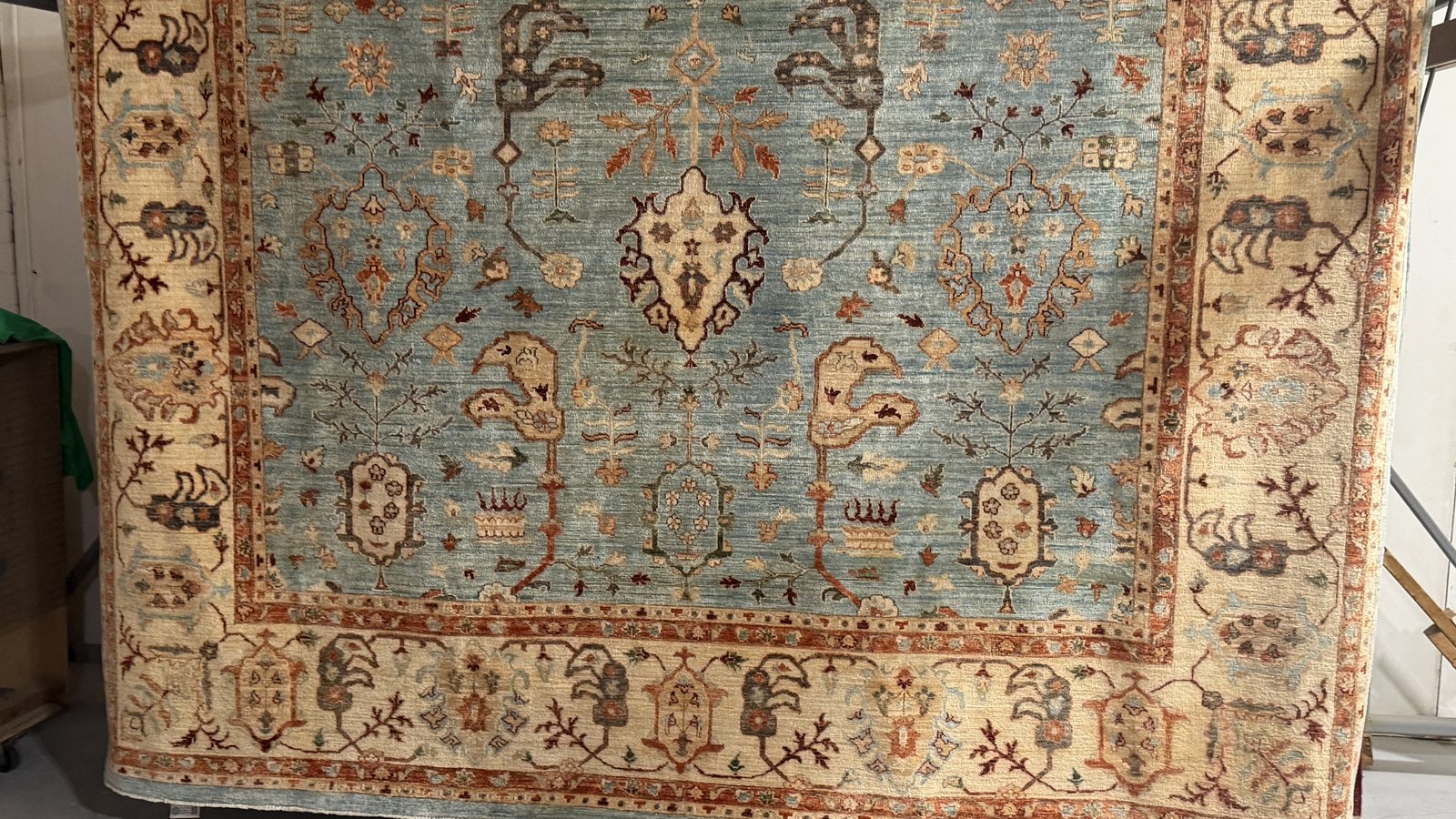
A finished wool rug on the rack, dry and waiting to be rolled
A clean rug on the drying rack, before it is rolled and wrapped.
Step by Step

How the Wash Runs

Six stages in a fixed order. Rugs get damaged when one of them is skipped to save an afternoon.

Opened & Dye Tested

The rug is laid out flat and read from both faces: fiber and construction identified, existing damage logged, and every color swabbed to see whether it intends to stay put. That reading sets the wash plan, and anything found gets passed on to you.

Dusted Before Water

The dry load comes out first. A rug off a floor in this city is carrying house dust, oak and pine pollen, and red clay ground down to a powder, all of it settled at the base of the pile. Compressed air and controlled flexing shake it loose, and no single stage does more for how long the rug lasts.

Spot Work

Marks, accidents, mildew bloom and worn traffic lanes are each treated on their own terms with chemistry chosen for the fiber, then left to work rather than hurried. Neutral pH on wool and silk; synthetics will take something with more in it.

Immersion Wash

The rug goes under water and is worked by hand with soft brushes following the lie of the pile, so loosened soil lifts away instead of being driven back down. Fragile pieces and anything with a dye that moved on the swab take a low-moisture route.

Flushed, Then Dried Flat

Flushing carries on until what comes off is clear, because detergent left behind will collect the next year of soil for you. The water is then drawn out mechanically and the rug dries flat under filtered moving air — never in sunlight, which fades dye and hardens wool.

Groomed & Checked

Pile is set back in its direction, the ends are cleaned and straightened, and the rug is read against the intake notes. Anything that did not come out is pointed out before it is wrapped rather than after it is on your floor.

Recent work

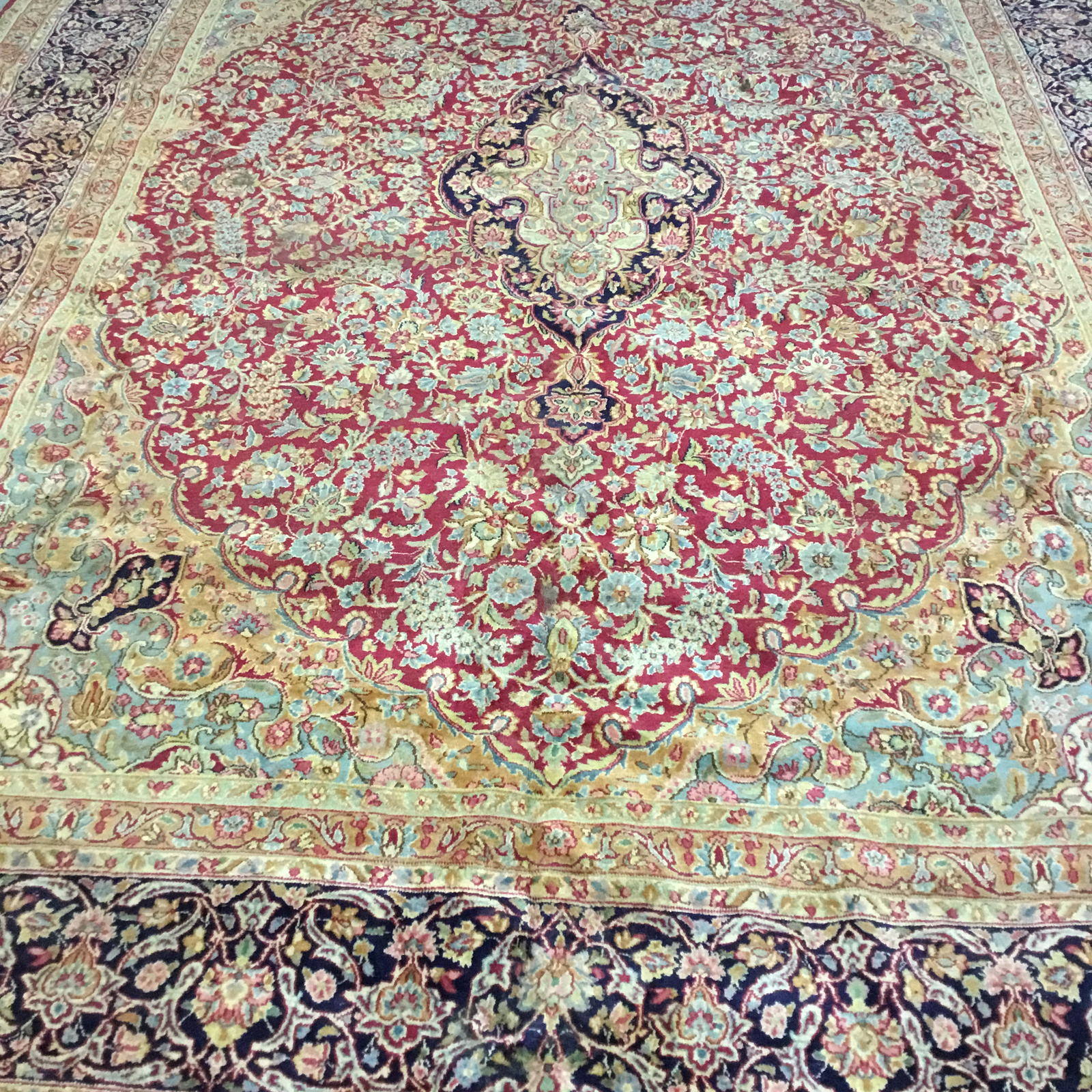
Before and After

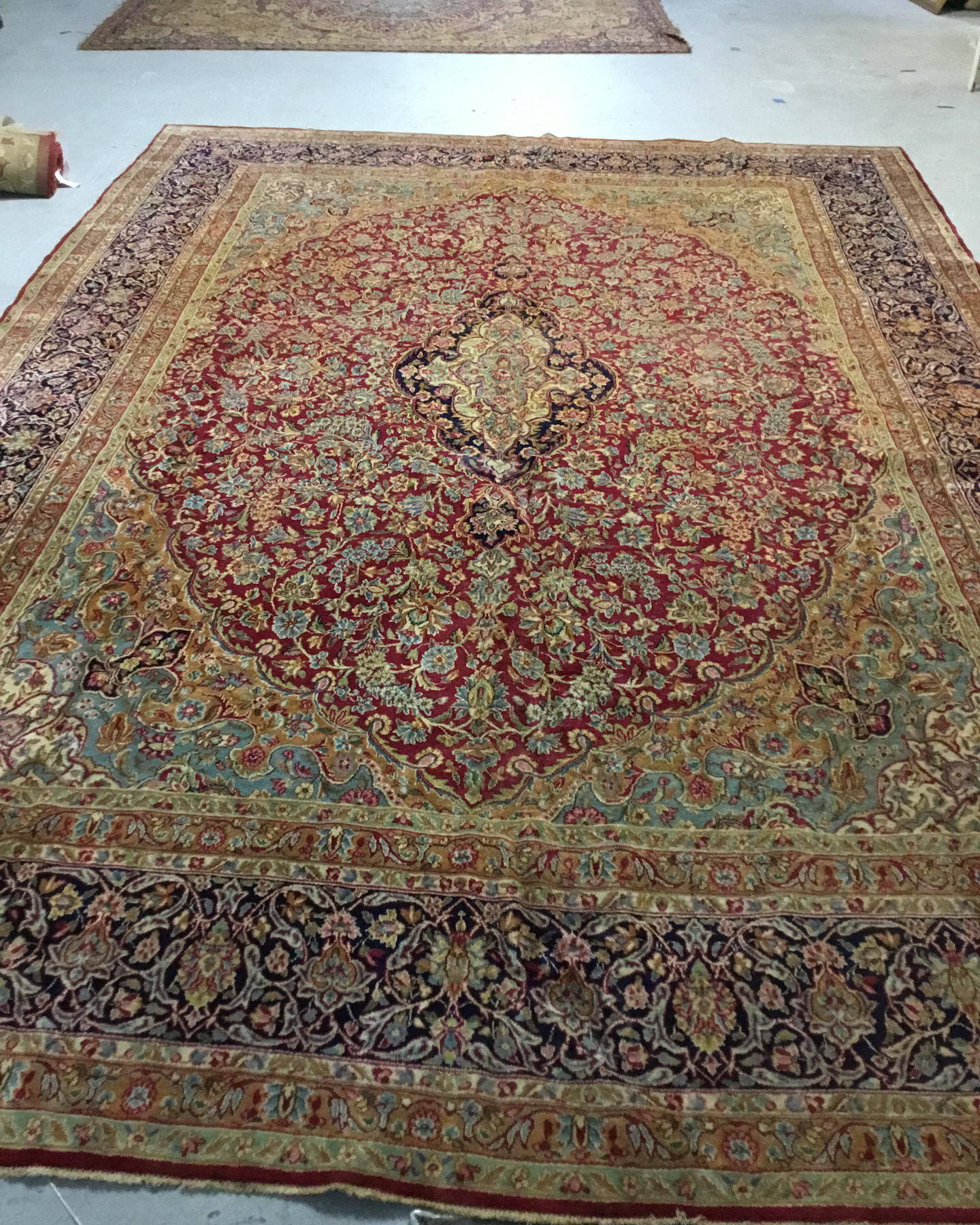
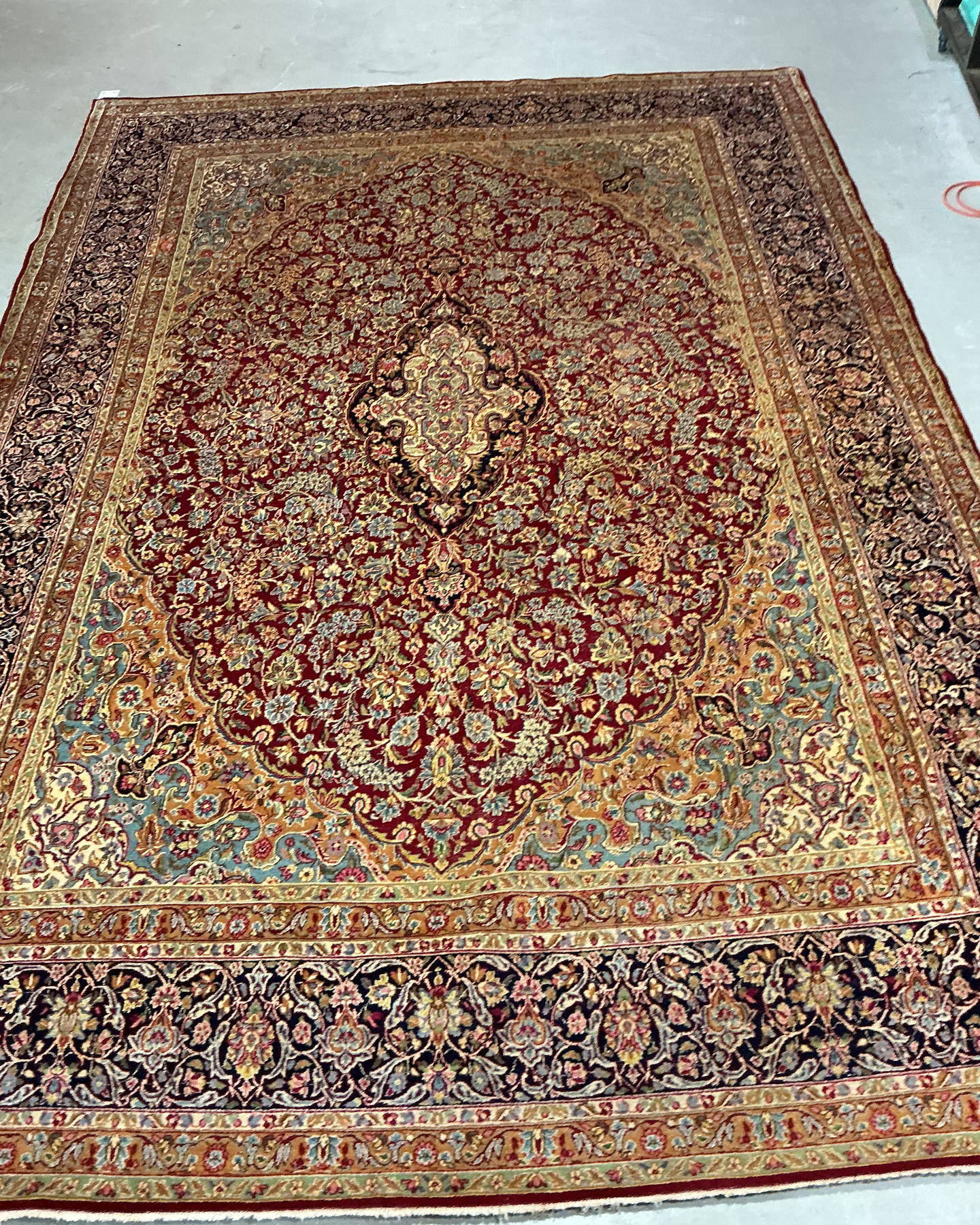
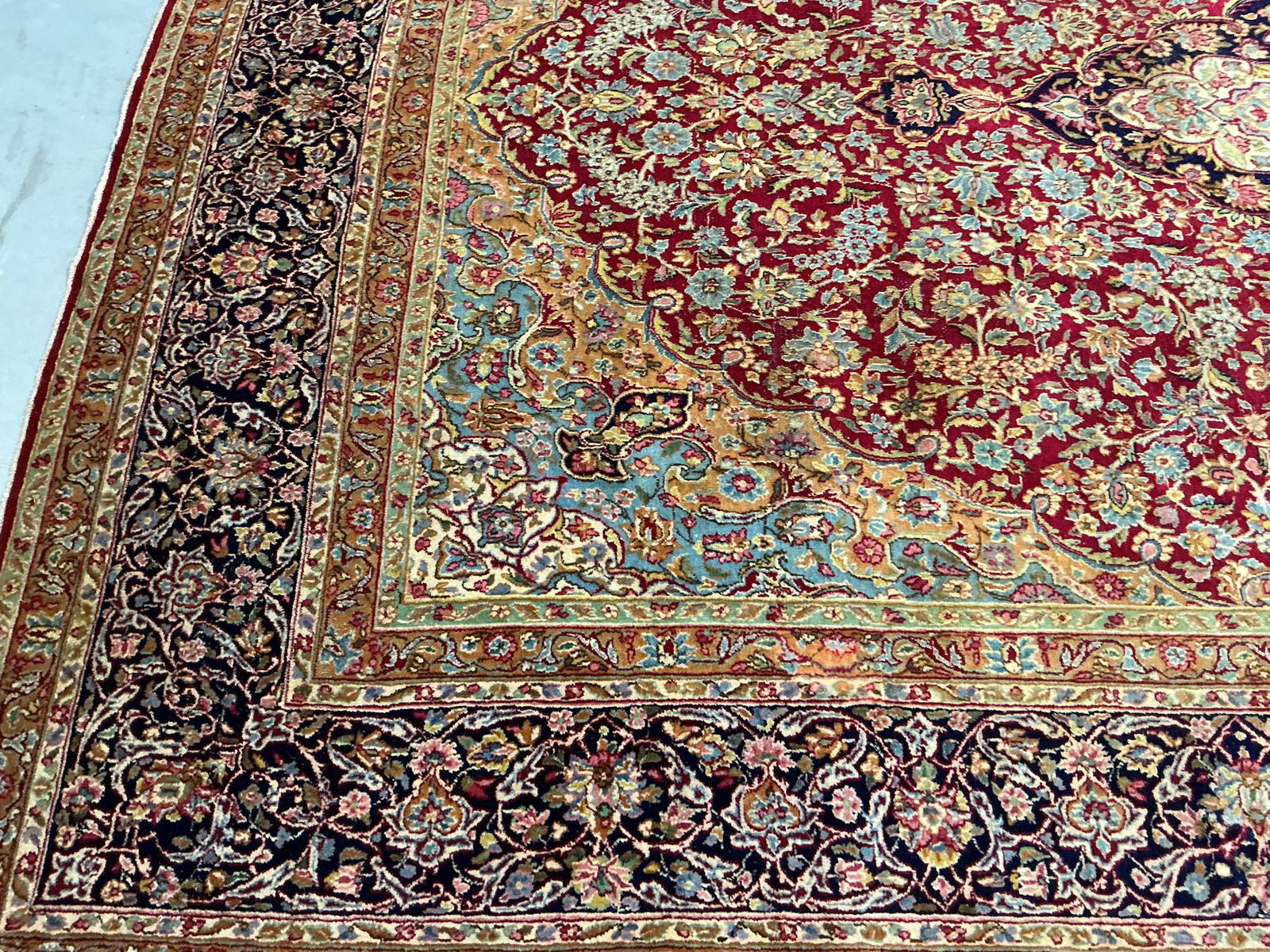
One hand-knotted Persian rug, photographed before and after cleaning.

Before
Hand-knotted Persian rug before cleaning, the deep red field and blue-green floral tracery muted and greyed
After
The same rug after cleaning, with the red field, gold corner spandrels and blue-green florals showing clearly
A hand-knotted Persian, before and after cleaning.
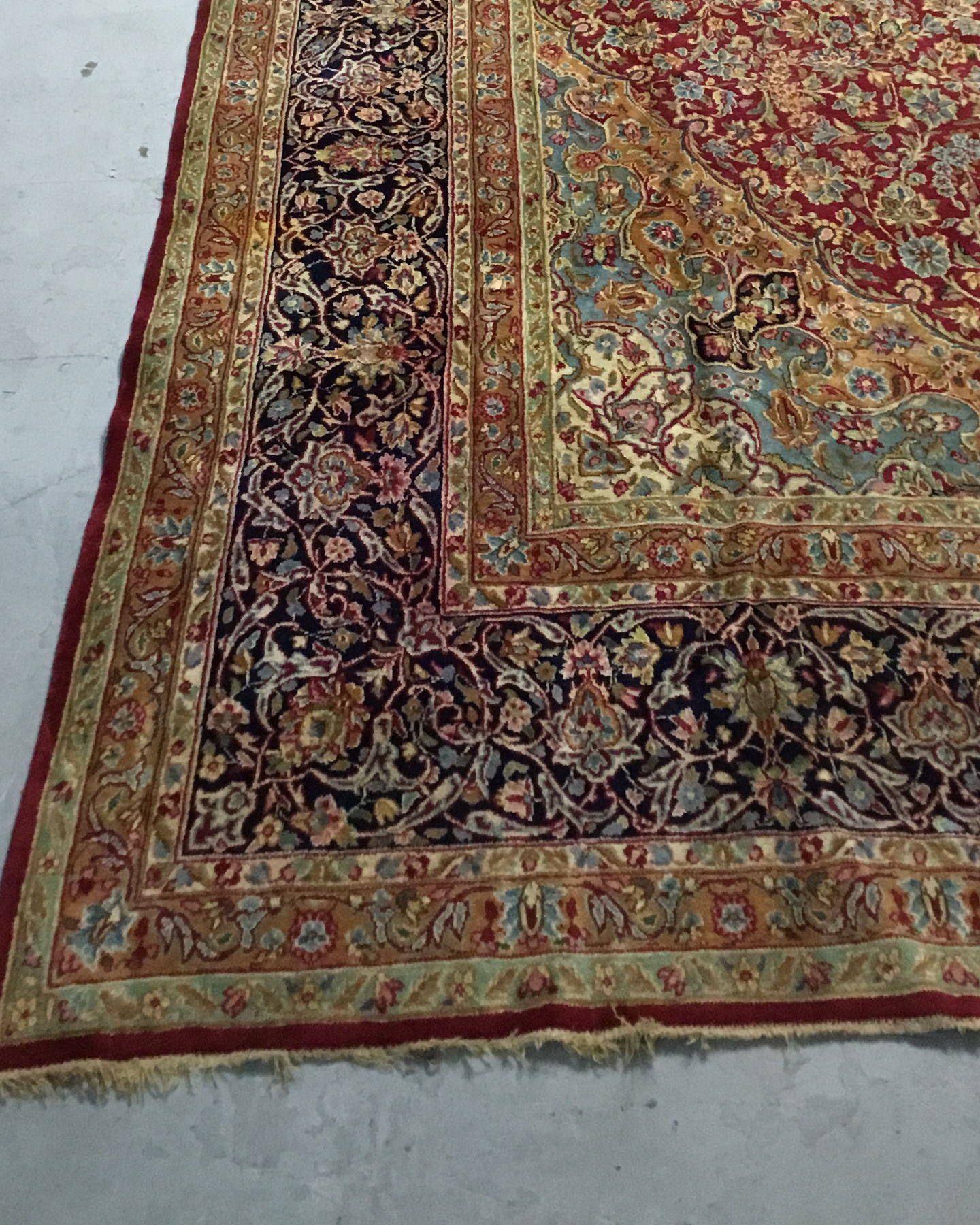
Before
Corner of the same rug before cleaning, the navy border and ivory fringe dulled and flattened in tone
After
The same corner after cleaning, with the navy border, gold guard bands and ivory fringe distinct again
Corner detail — border, guard stripes and fringe.
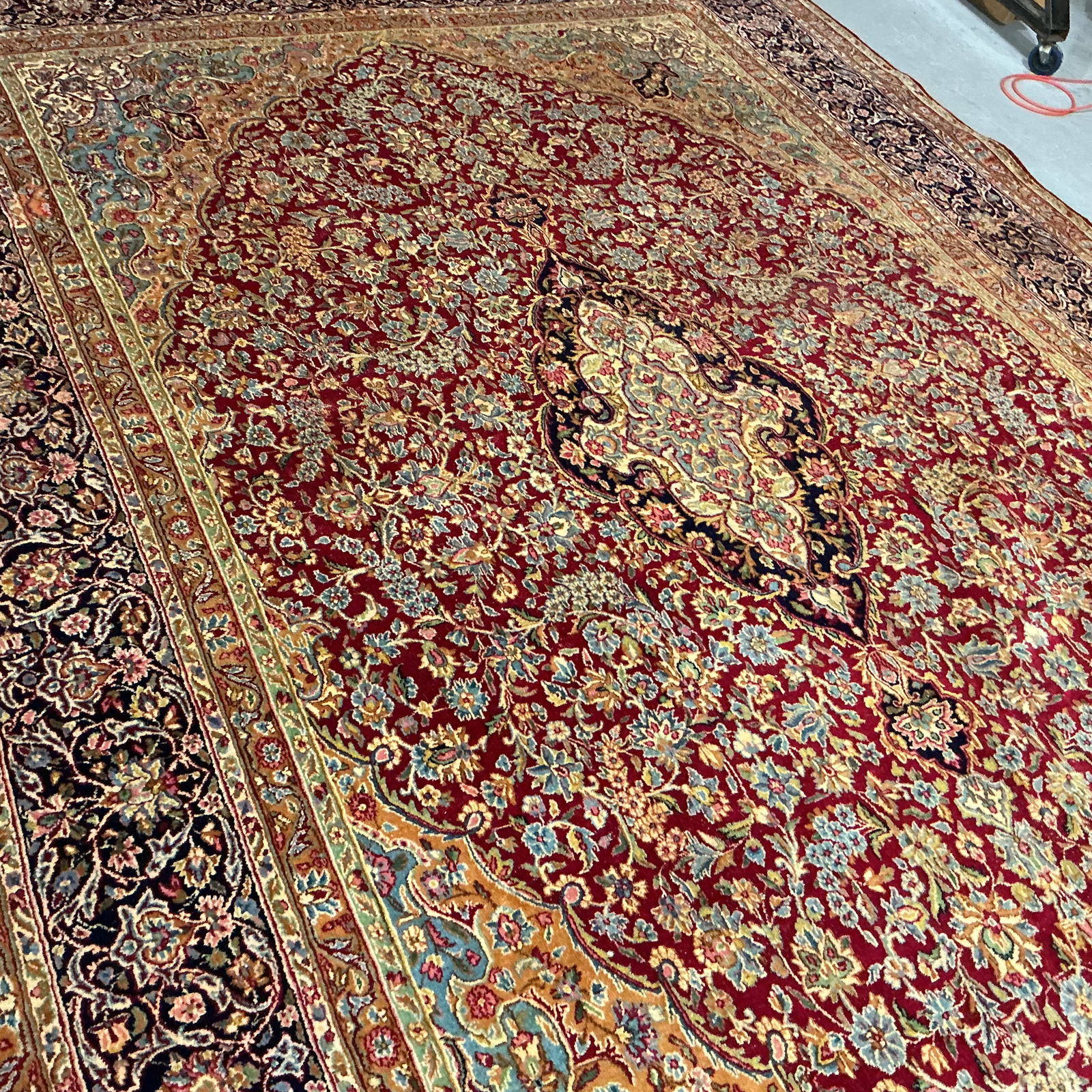
Before
Centre of the same rug before cleaning, the navy medallion and red field hazy and low in contrast
After
The same medallion after cleaning, the cream and gold palmette reading crisply against the navy and red
The central medallion and the field around it.
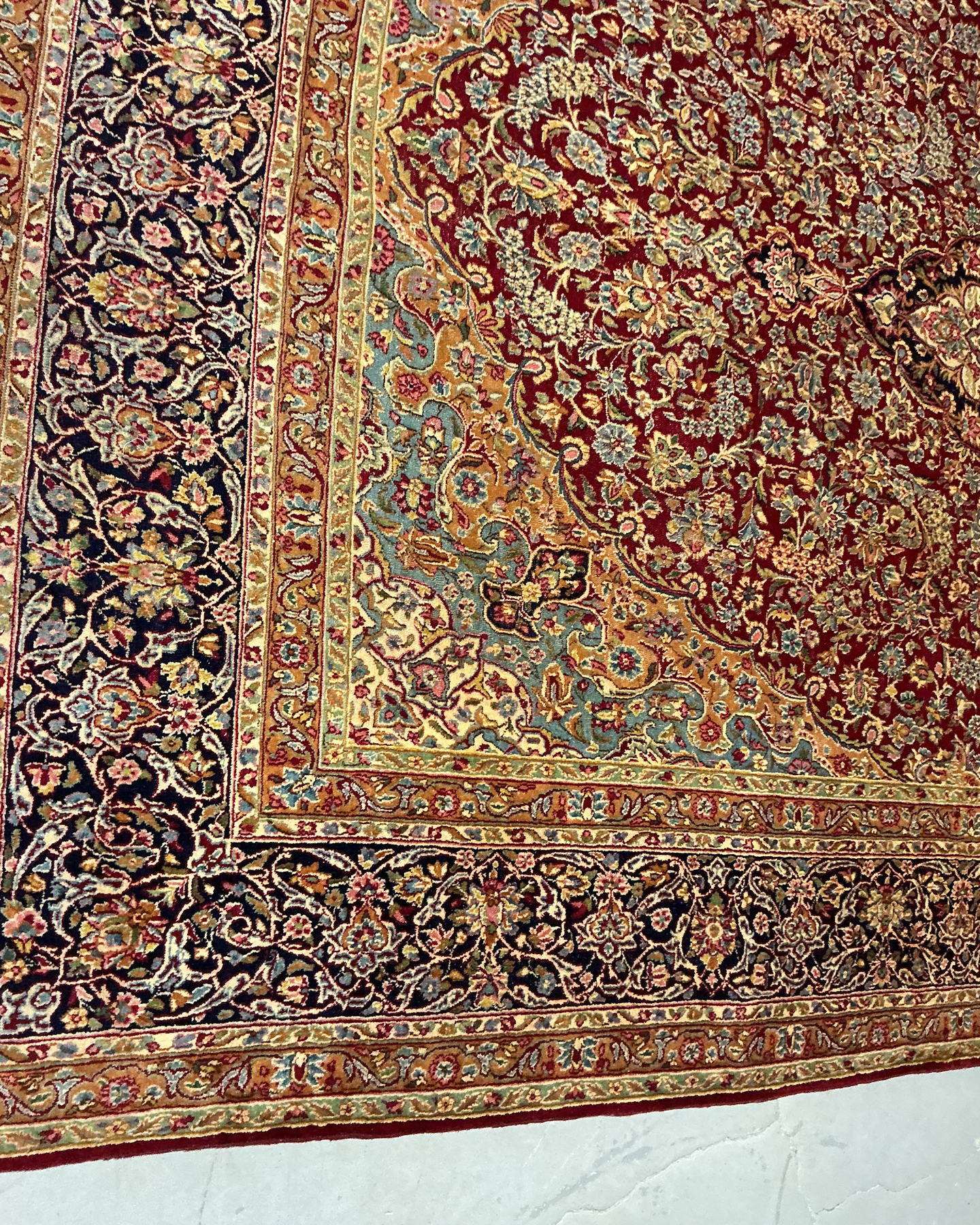
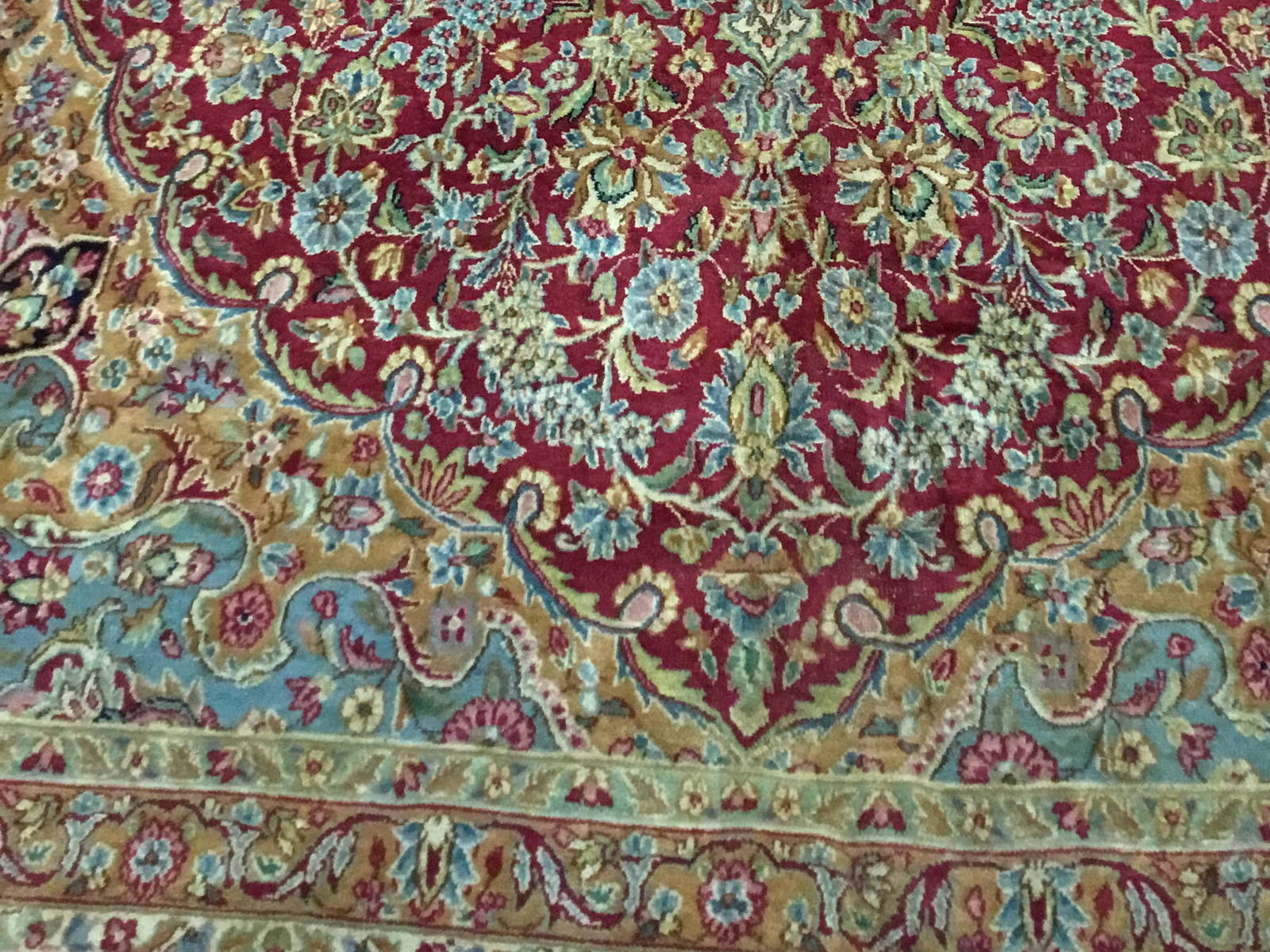
Before
Field meeting border on the same rug before cleaning, the blues and pinks greyed and indistinct
After
The same section after cleaning, with the pale blue scrollwork and pink florals separated and legible
Where the field meets the border.
Local Conditions

Drying a Rug in Birmingham Air

Birmingham gives a rug 155 damp days and 30 freezing nights a year, which is two completely different drying environments in the same house. Knowing which half of the year a rug has been sitting through changes what we expect to find in it before it is even unrolled.

71.1%
Mean relative humidity, five-year average
106
Days a year at or above 80% relative humidity
23
Longest unbroken damp run, in days
134
Days a year with measurable rain

Rain, and the trip to the workshop

134 days a year here see measurable rain, totalling 55.3 inches, so a rug leaving the house is wrapped for the weather rather than for the look of it.

It is also why we would rather collect a wet rug than have it wait: a rug that is already damp when it is rolled is in the worst possible condition for sitting still.

Why it cannot dry where it lies

A rug washed in the room it lives in has to give its water back to that room's air, and for 23 days at a stretch Birmingham air is already at or above 75%.

Air that damp takes water out of a rug slowly at best, which is the whole problem with in-home wand cleaning here: the pile dries, the foundation does not, and the rug smells fine for a few weeks and then does not.

The pile is not the part that matters

Wool will carry close to a third of its own weight in water without feeling wet, and on the 106 days a year that reach 80% relative humidity it is doing exactly that.

So a rug that feels dry to the hand can have a loaded foundation, which is why drying is taken to moisture readings rather than to touch, and why the back of a rug tells you more than the front.

The floor the rug goes back onto

Mountain Brook, Homewood and Forest Park keep their original board floors, which matters on the way back more than on the way out.

A rug put down on a board floor that is itself damp will wick from it, so the floor is worth checking while the rug is away rather than after it returns.

Much of English Village, Highland Park and Southside is condominium stock, where the rug usually has to come out through a corridor and a service elevator rather than a front door.

Rolling a rug for that trip is fine dry and a bad idea wet, which is one of several reasons the wash does not happen in the building.

Housing on this route starts in the 1890s, so a fair number of these rugs are drying onto floors that are older than any vapor barrier — a detail worth settling before the rug comes back.

Humidity, rainfall and temperature figures are from the ERA5 reanalysis record for the five years from 2021 through 2025, measured at the center of the Birmingham service area.

What We Accept

Fibers and What Each One Needs

If it lies on a floor there is a right way to wash it. The construction decides which.

Construction types and the handling each of them calls for.
Rug type How we handle it
Hand-knotted Persian & oriental Immersion, once the dyes have been swabbed and cleared. Ends worked by hand. Older pieces get gentler agitation and a longer spell on the drying floor.
Wool area rugs Neutral-pH immersion. The lanolin stays in the fiber rather than being stripped out of it, because that is what makes wool shed soil in the first place.
Silk & art silk (viscose) Low-moisture work only. Viscose yellows and goes stiff the moment it is over-wetted, so it is never put in a bath.
Cotton flatweaves & dhurries Washed on tight moisture control and dried under tension, so a weave meant to be used from both sides does not pucker or draw in.
Jute, sisal & seagrass Dry or barely-damp methods, nothing more. Plant fibers stain themselves with their own water, and in a house this humid they are the first thing on the floor to go musty.
Hand-tufted rugs Washed around the adhesive layer rather than through it. That layer is what ages badly, and it is the source of the old-glue smell owners cannot place.
Machine-made synthetics Polypropylene, nylon and polyester will take a hard wash and a stronger pre-treatment, and they come back looking considerably better than owners expect.
Shag, hides & sheepskin Handled apart from everything else, with agents chosen for the fiber and hand finishing at the end to put the loft back.
Local Specialties

Three Things That Turn Up in Birmingham Rugs

Oak Pollen & the Musty Smell

Pollen off the oaks and pines is resinous rather than inert. It turns tacky as the humidity comes up and then catches every other particle that lands on it, which is why a vacuum hardly touches the stuff. The smell that arrives after a wet winter, or after a rug has spent a season rolled up in a garage, is microbial growth down in the foundation; it is flushed out in the wash and followed with an antimicrobial. A deodorizing spray over the top of it survives until the next humid week and no longer.

Red Clay

The clay here is iron-rich and grinds down to a particle fine enough to wedge between the scales of a wool fiber instead of resting on top of it. That is why it pales under a vacuum and then comes back as a rust-colored shadow the next time the rug is damp. It has to leave dry, ahead of any water, and then be flushed rather than scrubbed — working it in wet is precisely how it becomes permanent.

Pet Accidents

The salts left behind stay in the foundation and draw moisture back out of the air every time it turns humid, which in this city is a long stretch of the year. Left alone they also burn the dye out from underneath. The contamination is flushed out wholesale, and the discoloration is corrected wherever the dye below it survived.

How This Is Arranged

Washed Away From the House

Rugs are collected, washed elsewhere and dried flat in moving air — not hung sodden over a rail and not dried on the floor they came off.

Right Method per Fiber

Fibers identified and dyes swabbed before any water. Neutral chemistry on wool and silk; anything stronger only where the construction can take it.

Collection & Delivery

Jefferson and Shelby counties, both journeys, no charge. The furniture standing on the rug gets shifted as part of it.

Told Straight

You hear what turned up at intake, what the work comes to, and which marks are staying. Nothing begins until you have agreed to it.

Questions

Questions We Get Asked

How long is my rug gone for?
A timeline comes with the quote, before anything is committed. Drying is the part that takes its time, and it takes longer in a humid stretch, because a rug leaves when the meter says it is dry rather than when the diary says so. Heavy pet contamination, a dye that ran, or repair work will all add to it, and you hear that at the start instead of on the day you expected delivery.
Is there anything you will not take?
Very little. Hand-knotted Persian and oriental work, wool, silk, cotton flatweaves, jute and sisal, hand-tufted pieces, machine-made synthetics, hides and shag all come through. What changes is the method: old silk and viscose are kept out of water entirely and handled dry.
Is the collection genuinely included?
It is, anywhere in Jefferson or Shelby county. We come to the house, move whatever is standing on the rug, take it away, and bring it back rolled and ready to go down again. Neither journey appears on the invoice.
Could washing shrink it or make the colors run?
Not where the wash has been matched to the rug. Every color is swabbed before water reaches the pile, and a dye that moves on the swab changes the method — either to low moisture or to a wash with a setting stage in it. Shrinkage comes from soaking a cotton foundation and then drying it while it is pulled tight, which is the exact thing controlled flat drying is arranged to avoid.
How often does a rug here need washing?
For a rug in a room the household actually uses, somewhere between a year and a year and a half is a reasonable rhythm. That is tighter than the advice you will read nationally, and the reasons are all local: a hundred and fifty-five damp days a year, a heavy spring off the oaks, and red clay arriving on shoes in every season. A rug in a guest room can go two or three years without much argument. A rug that has been wet is a different question and should not wait at all.
Will the musty smell come out?
Generally, yes. The smell lives in the foundation rather than on the surface, so it has to be flushed out in a full immersion wash and then treated. Sprays cover it, and the cover lasts until the next humid week. Where the cotton has already started to break down you are looking at a repair as much as a wash, and we will say which of the two it is rather than washing it twice and hoping.
How is the work priced?
By the square foot, adjusted for fiber, construction and the state the rug is in — a machine-made synthetic and a hand-knotted silk are not remotely the same afternoon. You have the figure before anything starts, the estimate itself costs nothing, and the total does not grow between collection and delivery. Send the details and we will come back to you.
Should I have the rug washed before we finish the lower room?
Yes, and it is worth doing in that order. A rug is easiest to keep clean when the floor it returns to has been sorted out first, and on a house that steps down its lot the lowest room is where water ends up. Sending the rug away while that work is going on also keeps construction dust out of a pile that has just been flushed clean.
Get In Touch

Get It on the Route

Tell us roughly what you have and which side of the mountain you are on, and we will fit it into a run.

  • Service area
    Jefferson County and Shelby County, Alabama
    Collection & delivery included throughout
  • Hours
    Mon–Sat: 9:00 AM – 5:00 PM
    Sunday: Closed

Free Cleaning Estimate

Want the Rug Back the Way You Remember It?

The estimate costs nothing, both journeys are included, and the rug that comes back is the one you bought.

Rug Repair & Reweaving

Ends, selvedges, moth grazing and reweaving — what is fixable, and what fixing it involves.

Repair services

Wet-Room Recovery

What to do in the first two days after a leak, or after water finds the lowest room in the house.

Water damage

The Rug Owner’s Guide

Knots, fibers and construction, and how to look after all of it through a long Alabama summer.

Read the guide
Start a Free Estimate Service Areas